
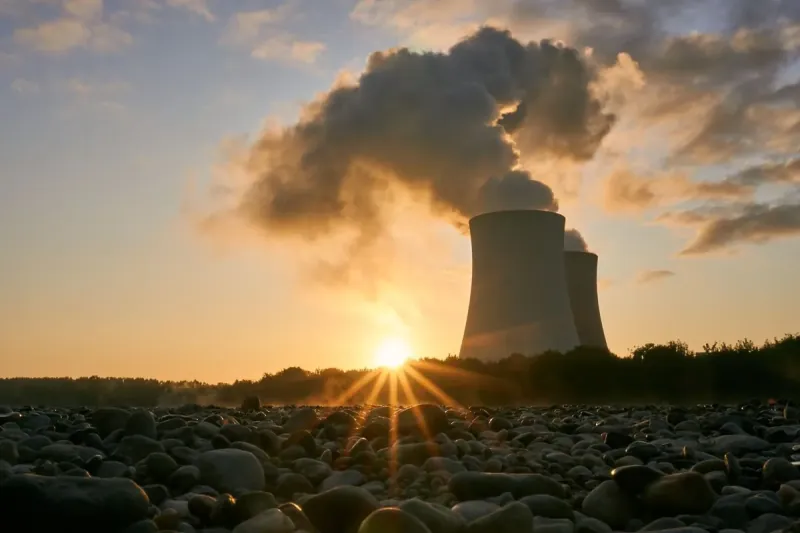
Commercial Use Of Modular Nuclear Reactors (SMRs) Will Become Widespread.
c4cdff538809db6a · Resolution source: aa.com.trCommercial Use Of Modular Nuclear Reactors (SMRs) Will Become Widespread.
Commercial Use Of Modular Nuclear Reactors (SMRs) Will Become Widespread. Probability: 50%. Confidence Level: Medium.
What Are Small Modular Reactors (SMRs) And Why Do They Matter?
Small Modular Reactors (SMRs) are advanced nuclear reactors with a power capacity of up to 300 MW(e) per unit. Unlike traditional large-scale nuclear plants, SMRs are designed for factory fabrication and can be transported and assembled on-site. This approach aims to reduce capital costs and shorten construction timelines. Learn more about SMR basics from the International Atomic Energy Agency (IAEA) at iaea.org.
The core advantage of SMRs lies in their modularity. Components are built in controlled factory settings, which improves quality control and reduces on-site delays. For urban and industrial applications, SMRs offer a low-carbon alternative to fossil fuels, especially for district heating or powering remote facilities.
Will SMR Commercial Use Be Widespread By 2035?
The prediction states a 50% probability that SMRs will achieve widespread commercial use by 2035. The verification criterion requires that in at least several countries, SMRs are connected to the grid for commercial electricity generation, with multiple operational plants. As of 2025, this outcome remains uncertain.
Current operational examples are limited to Russia's floating plant Akademik Lomonosov and China's HTR-PM prototype. In the United States, NuScale Power canceled its first project due to rising costs. Canada and the UK are still in the design certification phase. According to the World Nuclear Association, over 80 SMR designs are under development globally, but regulatory approval is slow.
What Are The Main Barriers To SMR Deployment Before 2035?
The first barrier is licensing. Regulators like the US Nuclear Regulatory Commission (NRC) are adapting to new safety paradigms, but the process remains lengthy. See updates at nrc.gov. Second, financing is a major hurdle. First-of-a-kind projects face high risk premiums, making it difficult to secure private investment without government subsidies.
Third, supply chains for specialized components are not yet mature. Finally, public acceptance and nuclear waste management remain unresolved issues. A report by the OECD Nuclear Energy Agency (NEA) highlights that regulatory harmonization is critical to reduce costs.
Which Countries Are Leading In SMR Development?
China is advancing with the HTR-PM, a high-temperature gas-cooled reactor connected to the grid in 2021. Russia operates the world's first floating SMR. Canada's regulator has completed a vendor design review for several SMRs. The UK is funding the Rolls-Royce SMR program. However, none of these have reached a fleet scale of multiple commercial units.
For a detailed status map, check the World Nuclear Association's SMR page at world-nuclear.org.
How Do SMR Costs Compare To Large Nuclear Plants?
SMRs promise lower upfront capital costs per unit, but the cost per kilowatt-hour is often higher for early deployments. The lack of economies of scale in first projects leads to cost overruns. For example, NuScale's initial project cost estimate rose by over 50% before cancellation. However, if factory production reaches high volumes, costs could drop by 30-40%, according to a study by the Energy Innovation Reform Project.
What Are The Safety And Security Concerns For SMRs?
SMRs use passive safety systems, meaning they require no active intervention to shut down safely. This reduces the risk of accidents. However, new designs like microreactors may be deployed in remote areas, raising concerns about physical security and fuel transport. The IAEA has published safety guidelines specific to SMRs, available at iaea.org.
The regulatory framework for emergency planning zones is also different. Smaller reactors may require smaller exclusion zones, which is attractive for urban siting. But this is not yet proven at scale.
What Is The Role Of SMRs In Achieving Carbon Neutrality?
SMRs can complement renewable energy sources by providing steady baseload power. They are suitable for industrial heat applications, such as hydrogen production or desalination. Many countries include SMRs in their net-zero roadmaps. For instance, the US Department of Energy's Advanced Reactor Demonstration Program (ARDP) funds projects targeting deployment by the late 2020s. Details are at energy.gov.
However, the timeline to 2035 is tight. Most projects are still in early construction. Even with expedited licensing, achieving multiple operational plants across several countries by 2035 is challenging but not impossible.
Frequently Asked Questions
1. What Is The Difference Between An SMR And A Conventional Nuclear Reactor?
An SMR has a power output of up to 300 MW(e) per unit, while conventional reactors often exceed 1,000 MW(e). SMRs are built in modules in factories and then assembled on-site, which reduces construction time and cost. Conventional reactors are typically custom-built on-site, leading to higher capital costs and longer schedules. SMRs also use passive safety systems that rely on natural convection and gravity for cooling.
2. Are There Any SMRs Currently Operating Commercially?
Yes, but very few. Russia's Akademik Lomonosov, a floating SMR, began commercial operation in 2020. China's HTR-PM, a high-temperature gas-cooled reactor, achieved grid connection in 2021 and is in demonstration phase. No other SMRs are operating at commercial scale as of 2025. Most projects in the US, Canada, and Europe are awaiting final design approval or are under construction.
3. What Is The Realistic Timeline For SMR Commercialization?
Based on current progress, the earliest realistic timeline for multiple commercial SMRs is 2030-2035. This requires successful completion of first-of-a-kind projects, regulatory reform, and supply chain development. If these factors align, the 50% probability by 2035 is plausible. However, delays in licensing or financing could push widespread adoption to 2040. The IAEA projects that SMRs could contribute about 10% of global nuclear capacity by 2050 under a high-growth scenario.
Related Predictions
- Climate-resilient Infrastructure Will Become Mandatory In All New Projects. 2035 · City
- Smart Glass Will Become Widespread In Generating Energy And Regulating Heat. 2035 · City
- Desalination Capacity Will Increase By 50% 2035 · City
- Autonomous Shuttle Vehicles Operating In 50+ Cities 2035 · City
- Climate-resilient Infrastructure Becomes A Standard Budget Line Item 2033 · City