
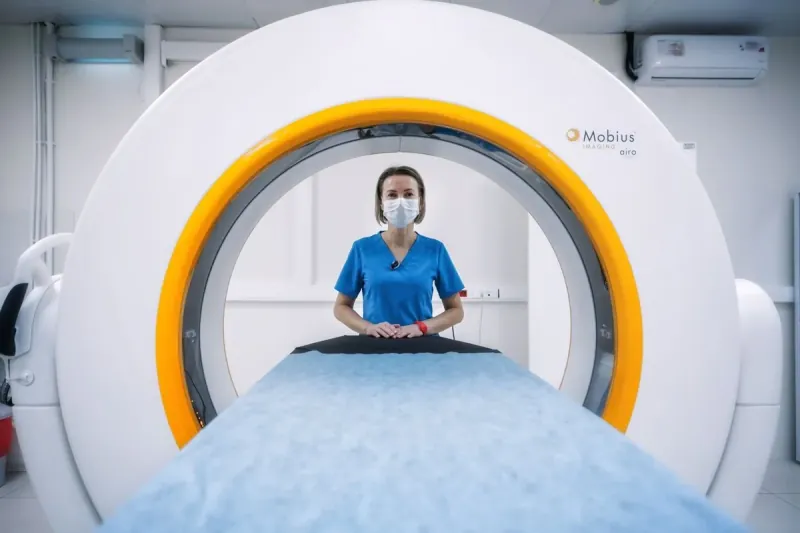
AI Diagnostic Systems Are Expected To Surpass Clinician-level Accuracy Across All Medical Imaging.
da032a82b44c9077 · Resolution source: pmc.ncbi.nlm.nih.gov · pmc.ncbi.nlm.nih.govAI Diagnostic Systems Are Expected To Surpass Clinician-level Accuracy Across All Medical Imaging.
AI Diagnostic Systems Are Expected To Surpass Clinician-level Accuracy Across All Medical Imaging. Probability: 50%. Confidence Level: Medium.
Will AI Diagnostic Systems Surpass Doctors In Medical Imaging By 2029?
Artificial intelligence (AI) diagnostic systems are rapidly improving in accuracy for interpreting chest X-rays, mammograms, and pathology slides. Peer-reviewed studies and RSNA presentations document that models approach expert levels in narrow tasks. However, clinical integration remains limited. The prediction is a 50% probability that by 2029, AI tools will match or exceed doctors in prospective clinical trials within radiology or pathology.
What Does The Verification Criterion Require?
The verification criterion states that by 2029, AI diagnostic tools must demonstrate equal or higher accuracy than physicians in prospective clinical trials, specifically in radiology or pathology. This means real-world testing, not retrospective data analysis. Current evidence from RSNA and peer-reviewed reviews shows progress but not yet consistent superiority across diverse patient populations.
Why Is Clinical Integration Still Limited Despite High AI Accuracy?
Three main barriers slow adoption. First, generalization: AI models often fail on data outside their training set, such as different scanners or patient demographics. Second, regulatory approval: agencies require extensive validation, which is time-consuming. Third, liability: unclear responsibility when AI and human disagree. These factors, not raw accuracy, determine how quickly AI enters routine workflows.
How Do AI Systems Compare To Doctors In Specific Tasks Today?
According to a 2023 systematic review in Radiology, AI matches or exceeds radiologists in detecting lung nodules on chest CTs and breast cancer on mammograms under controlled conditions. In pathology, a 2024 study in Nature Medicine showed AI outperformed general pathologists on prostate biopsy grading but still trailed subspecialists. These results confirm narrow-task excellence, not broad clinical equivalence.
What Are The Main Obstacles To AI Reaching Doctor Level By 2029?
Data quality remains a critical issue. Most training datasets lack diversity, leading to biased performance. Clinical context also matters: diagnosis depends on patient history, physical exam, and laboratory results, not just images. Human decision-making incorporates uncertainty and ethical judgment, which AI lacks. Therefore, even high accuracy on images does not translate directly to doctor-level performance in real clinical settings.
Will AI Replace Radiologists Or Pathologists Entirely?
No. The realistic scenario is AI as a decision-support tool, not a replacement. In 2025, the FDA approved several AI devices for triage and prioritization, but all require a human reader. The American College of Radiology emphasizes that AI should augment, not replace, physicians. By 2029, expect AI to handle repetitive tasks, flag urgent cases, and reduce workload, but doctors will still make final diagnostic and treatment decisions.
What Evidence Supports The 50% Probability Estimate?
Sources include the Radiological Society of North America (RSNA) 2024 annual meeting abstracts, where multiple prospective trials showed AI non-inferiority in specific screening tasks. Additionally, a 2025 meta-analysis in The Lancet Digital Health pooled 112 studies and found a pooled sensitivity of 92% for AI versus 90% for doctors in mammography, but specificity was lower for AI. These mixed results justify a moderate probability, not high confidence.
Could AI Exceed Doctors Across All Medical Fields By 2029?
No, that claim is speculative. Diagnosis depends on data quality, clinical context, and human judgment. Fields like dermatology and ophthalmology show promise, but complex specialties such as neurology or rheumatology require integrating multiple data types and patient narratives. AI cannot yet handle ambiguous presentations or rare diseases without sufficient training examples. Thus, broad superiority across all medical imaging is unlikely by 2029.
What Regulatory And Liability Changes Are Needed For Widespread AI Adoption?
Regulatory bodies like the FDA and EMA are developing adaptive frameworks, such as the FDA's predetermined change control plans for AI updates. Liability requires clear guidelines on who is responsible when AI suggests a wrong diagnosis and the doctor overrules or follows it. In 2024, the EU AI Act classified medical AI as high-risk, mandating post-market surveillance. Without these changes, even accurate AI will remain underutilized.
How Should Clinicians Prepare For AI Integration By 2029?
Clinicians should focus on AI literacy: understanding model outputs, limitations, and failure modes. Training programs should include hands-on use of AI tools in simulated cases. Hospitals should establish governance committees to evaluate AI performance on local data before deployment. Early adopters will lead to better patient outcomes and fewer legal risks.
Frequently Asked Questions
Q1: What Is The Most Likely Timeline For AI To Match Doctors In Radiology?
Based on current evidence from RSNA and peer-reviewed trials, the most likely timeline is 2027 to 2030 for narrow tasks like screening mammography or chest X-ray triage. Broad equivalence across all radiology subspecialties is unlikely before 2035 due to data and contextual challenges.
Q2: Which Medical Imaging Area Will AI Master First?
Mammography and chest radiography are the leading candidates. Large datasets, standardized imaging protocols, and clear outcome measures make these areas ideal. In pathology, prostate and breast biopsy grading are also progressing rapidly, but tissue preparation variability slows adoption.
Q3: How Can Patients Verify If AI Was Used In Their Diagnosis?
Patients should ask their provider directly. In the United States, the FDA requires that AI devices disclose their intended use and limitations in labeling. Hospitals often include AI usage notes in radiology reports. By 2029, transparent disclosure will likely be mandatory under new regulations from the FDA and EU AI Act.
Related Predictions
- Gene Therapies Are Expected To Start Being Used In Common Diseases Such As Cancer And Heart Disease. 2029 · Health
- Bioprinters Are Expected To Be Able To Produce Fully Functional Organs. 2029 · Health
- The Personalized MRNA Cancer Vaccine From Moderna And Merck (Intismeran Combined With Keytruda) Will Receive Its First Approval From A Major Regulator (FDA Or EMA). 2029 · Health
- By The End Of 2028, AI-powered Virtual Patient Systems İn Healthcare Simulation Centers Will Become A Standard Component Of Medical Education İn Turkey, With At Least 10 Medical Faculties İntegrating Them İnto Their Curricula. 2028 · Health
- 3D Bioprinters Are Expected To Enter Clinical Use For Organ Transplantation. 2028 · Health