
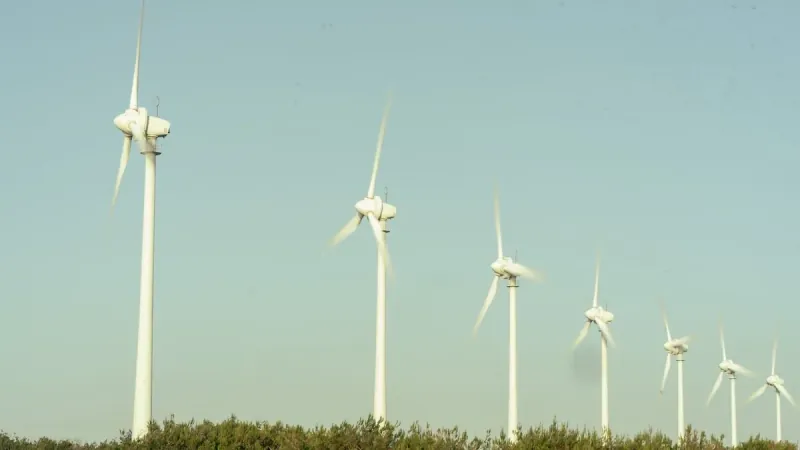
Floating Wind Farms Reaching 1 GW+ Capacity In Open Seas
681578553957ed99 · Resolution source: guncelpediatri.com · A Financial Analysis of Offshore Wind FarmsFloating Wind Farms Reaching 1 GW+ Capacity In Open Seas
Floating Wind Farms Reaching 1 GW+ Capacity In Open Seas Probability: 55%. Confidence Level: Medium.
Floating Wind Farms: Can They Reach A 1 GW Capacity By 2036?
Floating wind energy production is shifting towards deeper and more challenging areas as it expands beyond continental shelves and shallow waters. A key element in this transformation, floating wind turbines operate in deep waters of 60 meters or more, where fixed-foundation turbines cannot be installed. Can this technology achieve a total installed capacity of 1 GW for offshore wind farms by 2036? This target is considered a critical test for the industry and represents a significant turning point both technically and economically.
What Are The Current Status And Challenges?
Currently, floating wind energy remains largely limited to experimental and small-scale projects worldwide. As of 2024, global installed capacity stands at around 200 MW. Pilot projects in leading countries such as Norway, the United Kingdom, and Portugal have demonstrated the potential of deep waters, but struggle to reach commercial scale. Most existing facilities operate within the boundaries of a single energy zone with capacities ranging from 50 to 100 MW. This illustrates why the 1 GW target is ambitious - it requires the simultaneous commissioning of more than ten large-scale projects.
Do Cost Reduction And Economies Of Scale Support The Target?
The likelihood of achieving this goal depends on cost reductions and economies of scale. The production cost of floating platforms has decreased significantly over the past decade; however, it remains approximately twice that of fixed-foundation turbines. Stability in steel prices, maturation of supply chains, and widespread adoption of mass production techniques by the mid-2030s could close this gap. Furthermore, in regions with high wind potential but deep water, such as the North Sea and Japanese coastlines, there is currently no legal or physical alternative for floating systems. This geographical necessity is a powerful driver accelerating public and private sector investments. Challenges remain, however: High payback periods, inadequate seabed connection infrastructure, and uncertainty surrounding energy storage integration complicate project financing. The technology is still in its early stages, and costs are high; while 1 GW may be achieved by 2036, the scale of economies and infrastructure development remains uncertain.
Which Regions Could Be Pioneers?
The North Sea, Irish Sea, and Japanese coastlines stand out due to their depth advantages and strong wind regimes. Projects in the Scottish seas, for example, are already exceeding 100 MW capacity, signaling scalability. In the Mediterranean, France and Italy’s auction schedules offer promising prospects after 2028. Experience in these regions suggests that 1 GW could be achieved by the mid-2030s.
Frequently Asked Questions
At What Depths Can Floating Wind Turbines Operate?
Floating wind turbines operate in deep waters, typically ranging from 100 to 300 meters, where fixed-foundation turbines cannot be installed. This enables energy production in areas with limited continental shelves.
How Many Projects Are Needed To Reach A 1 GW Capacity?
Given an average project size of around 100 MW, at least 10 large-scale projects would need to be commissioned simultaneously to achieve 1 GW. This requires significant coordination from both a financial and logistical perspective.
When Will Floating Wind Costs Compete With Fixed-foundation Turbines?
Experts predict that the cost gap could shrink to around 30 percent as production scales up and supply chains mature by the mid-2030s. However, this depends on stability in steel prices and energy policies.
Related Predictions
- AI Systems Monitoring Ocean Biodiversity Will Be Operational In 2036. 2036 · Ocean
- Artificial Reefs For Marine Life Will Be Produced Using 3D Printing. 2036 · Ocean
- Seafloor Sensor Networks Operating As An Earthquake Early Warning System 2036 · Ocean
- Establishment Of A Global Sensor Network To Monitor Ocean Acidification 2035 · Ocean
- Smart Grid Systems Will Reduce Water Loss By 30%. 2035 · Ocean