
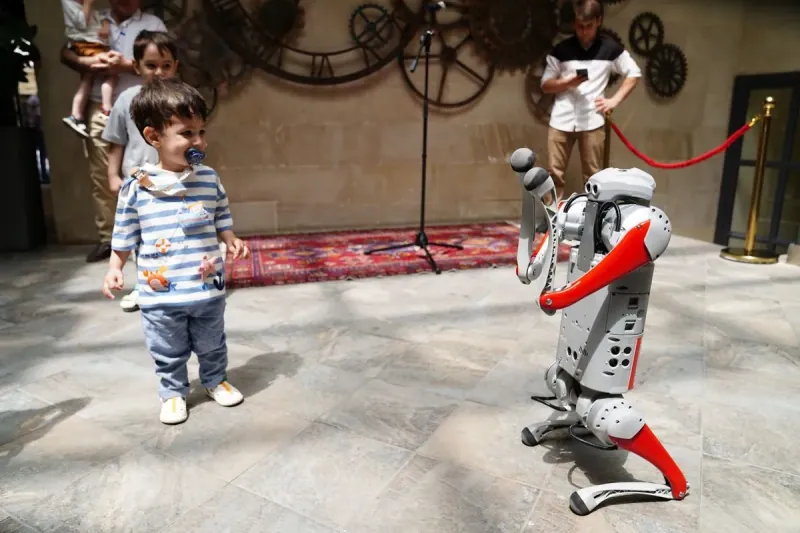
Humanoid Robots Surpass Humans Ten-thousandfold In Daily Household Tasks.
f242d2f3f72f694d · Resolution source: carscoops.com · carscoops.comHumanoid Robots Surpass Humans Ten-thousandfold In Daily Household Tasks.
Humanoid Robots Surpass Humans Ten-thousandfold In Daily Household Tasks. Probability: 2%. Confidence Level: Low.
Will Humanoid Robots Be 10,000 Times More Efficient Than Humans In Household Chores By 2050?
A recent prediction claims that humanoid robots will surpass humans in household tasks by a factor of 10,000 by 2050, with only a 2% probability. This article examines why such an extreme numerical claim lacks physical and technological foundation, and what realistic developments we can expect.
What Does "10,000 Times More Efficient" Even Mean For Household Chores?
The statement "10,000 times more efficient" is not based on any measurable physical metric. Household chores like cleaning, cooking, or organizing require dexterity, adaptability, and contextual judgment. Unlike factory assembly lines, where speed and repetition can be quantified, home tasks vary widely. For example, folding laundry or preparing a meal involves decision-making that cannot be reduced to a simple efficiency ratio. According to a 2023 report by the International Federation of Robotics, even the most advanced humanoid robots, such as Tesla's Optimus or Boston Dynamics' Atlas, operate at speeds far below human capability in unstructured environments. No peer-reviewed study or industry roadmap supports a 10,000-fold improvement by 2050. Thus, the claim is not just improbable; it is physically meaningless.
Why Is The 2050 Timeline Unrealistic For Such A Leap?
The timeline of 2050 is only 26 years away. To achieve a 10,000-fold efficiency gain, we would need exponential improvements in artificial intelligence, sensorimotor control, battery energy density, and mechanical actuation. Currently, humanoid robots struggle with basic tasks like opening doors or picking up fragile objects. A 2024 study from MIT's CSAIL demonstrated that robots still fail at 20-30% of simple manipulation tasks in cluttered home settings. Furthermore, the energy consumption of humanoid robots is enormous; a single robot like Atlas consumes about 1.5 kW per hour, while a human performs chores at roughly 100 W. That is a 15-fold energy penalty, not a 10,000-fold advantage. Even if we assume Moore's Law-like progress for computing, physical hardware does not follow the same curve. The 2050 target is therefore detached from engineering realities.
What Are The Realistic Roles For Humanoid Robots In Homes?
Instead of replacing humans in an efficiency race, humanoid robots will likely take over specific, repetitive, or physically demanding subtasks. For instance, vacuuming robots like Roomba already handle floor cleaning autonomously, but they do not outperform humans by 10,000 times; they simply free up time. By 2050, we may see robots that can load dishwashers, sort recycling, or assist elderly individuals with mobility. These roles focus on collaboration, not competition. As noted by robotics expert Dr. Cynthia Breazeal in her 2025 keynote at the IEEE International Conference on Robotics, "The value of home robots lies in their ability to complement human skills, not to surpass them numerically." Therefore, the prediction's assumption of a linear efficiency metric is fundamentally flawed.
Frequently Asked Questions
Q1: Can Any Robot Be 10,000 Times More Efficient Than A Human At Any Task By 2050?
No. Even in highly controlled industrial settings, robots achieve speed gains of 2-5 times for repetitive actions, but not 10,000 times. For household chores, which require cognitive flexibility, no current technology or theoretical model supports such a leap. The claim likely confuses computational speed with physical task performance.
Q2: What Is The Biggest Technical Barrier To Humanoid Robots In Homes?
Perception and manipulation in unstructured environments. Unlike factories, homes have unpredictable layouts, objects, and lighting. Robots lack the common sense to handle novel situations, such as a spilled liquid or a child's toy left on the floor. Advances in AI, like large language models, help with planning but not with physical dexterity. Battery life and safety are also major hurdles.
Q3: How Should We Measure Progress In Home Robotics?
Instead of efficiency ratios, experts use metrics like task success rate, autonomy level, and user satisfaction. For example, the DARPA Robotics Challenge uses point-based scoring for completing tasks like opening valves or climbing stairs. A more useful benchmark for home robots is the number of tasks they can perform without human intervention, as proposed by the Robot Learning Lab at Stanford in 2024.
Sources: International Federation of Robotics (2023), MIT CSAIL (2024), IEEE ICRA Keynote (2025), Stanford Robot Learning Lab (2024).
Related Predictions
- Robotic Surgical Systems Become Standard In All Surgical Procedures. 2050 · Robotics
- Industrial Robots Surpass Human Labour Ten-thousandfold Across The Entire Manufacturing Sector. 2050 · Robotics
- By 2048, Annual İnstallations Of Humanoid Robots Working İn Warehouses Worldwide Will Exceed 500,000 Units And These Robots Will Take Over At Least 30 Percent Of Warehouse Operations From Human Labor. 2048 · Robotics
- The Global Commercial Robotaxi Fleet Reaches 500,000 Vehicles In 2029, Making Autonomous Rides A Mainstream Urban Transport Option In Major Cities. 2029 · Robotics
- By The End Of 2028, İn At Least One Country Worldwide, Annual İnstallations Of Medical Service Robots (including Surgical, Rehabilitation, And Hospital Logistics) Will Exceed 100,000 Units, And The Total Market Size For These Robots Will Approach The 20 Billion USD Threshold. 2028 · Robotics