
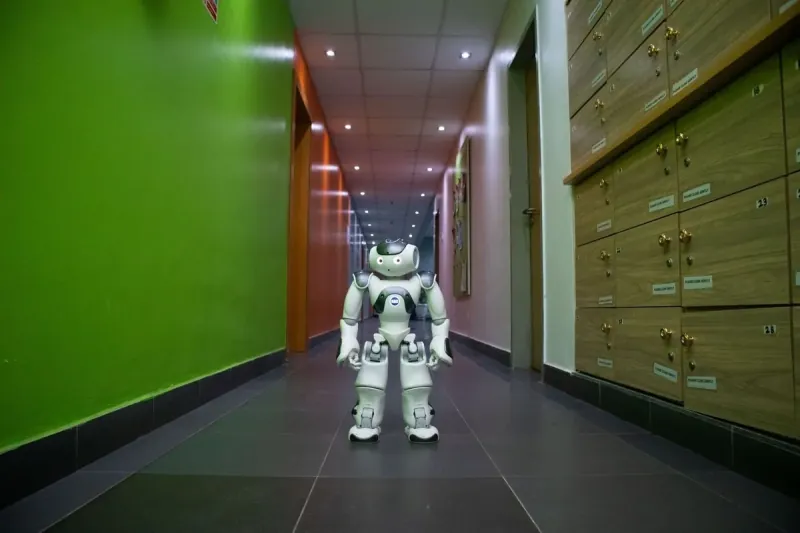
Humanoid Robots Work At Human Level In Daily Household Tasks.
3b06ea5b73681c42 · Resolution source: carscoops.com · carscoops.comHumanoid Robots Work At Human Level In Daily Household Tasks.
Humanoid Robots Work At Human Level In Daily Household Tasks. Probability: 30%. Confidence Level: Low.
Will Humanoid Robots Match Human Capability In Household Chores By 2030?
Humanoid robots working side by side with humans in homes, performing daily tasks at an equal skill level, is a bold vision. Current projections place a 30% probability on this achievement by 2030. This article examines the feasibility, required breakthroughs, and expert reasoning behind this forecast.
What Does "Equal Competence" Mean For Home Robots?
The verification criterion is strict: humanoid robots must handle household chores with equivalent proficiency to a human adult. This includes tasks like folding laundry, cooking varied meals, cleaning cluttered spaces, and adapting to new instructions. It is not about performing a single task well, but about general-purpose flexibility across unpredictable home environments.
Why Is Home Automation So Difficult For Robots?
Unlike factories with structured layouts, homes are chaotic. Objects shift, lighting changes, and tasks vary daily. A robot must combine advanced visual understanding, dexterous manipulation, and real-time adaptation. According to robotics researchers, this level of general intelligence remains unsolved. The current state of the art involves specialized robots that excel in narrow domains, such as vacuuming or mopping, but fail at broader, unstructured tasks.
What Breakthroughs Are Required By 2030?
To reach the 30% probability threshold, three major leaps are necessary. First, manipulation: robots need tactile sensors and motor control to handle soft, irregular objects like towels or fruit. Second, semantic understanding: they must interpret ambiguous commands like "clean up the mess" without explicit step-by-step guidance. Third, learning efficiency: current AI models require thousands of demonstrations, while humans learn from a few examples. A 2030 timeline would demand unprecedented progress in all three areas simultaneously.
Why Do Experts Assign Only A 30% Probability?
The fundamental reasoning behind this, according to experts, is that achieving human-like adaptability in domestic environments remains one of the most challenging unsolved problems in robotics. Despite increasing AI computing power, physical form and real-world testing are still falling behind digital simulations. As the analysis indicates, "Human-level flexibility in household chores is a major unresolved issue in robotics; this is an ambitious goal for 2030." This clearly shows that the difference between current specialized robots and general-purpose humanoids is too significant to close within six years.
What Is The Current State Of Humanoid Robot Development?
As of 2025, leading humanoid prototypes like Tesla Optimus and Figure 01 demonstrate walking and basic grasping, but they operate in controlled demos. No commercial humanoid has passed a standardized home chore test. The gap between lab showcases and reliable daily performance is substantial. According to industry reports, most companies target 2028-2030 for initial commercial pilots, not for full human equivalence.
Frequently Asked Questions
Can Humanoid Robots Cook And Clean Like A Professional Chef Or Cleaner By 2030?
No. While they may handle simple recipes or vacuuming, professional-level precision and speed in cooking or deep cleaning require years of human practice. Robots lack the sensory feedback and judgment for tasks like adjusting seasoning or handling delicate surfaces. The 30% probability refers to average human competence, not expert performance, and even that remains unlikely.
What Is The Biggest Technical Barrier To Home Humanoids?
General-purpose manipulation. Picking up a slippery glass, folding a fitted sheet, or opening a jar with variable force requires real-time tactile feedback and adaptive motor control. Current robotic grippers are far less capable than the human hand, and solving this is a prerequisite for any household chore.
If Not By 2030, When Might Humanoid Robots Achieve Household Parity?
Most conservative estimates place this between 2040 and 2050, assuming continuous progress in AI and materials science. The 2030 forecast with 30% probability is considered optimistic by many experts because it would require a scientific breakthrough rather than incremental improvement. For realistic planning, consumers should expect semi-autonomous helpers that handle specific tasks, not full human replacements, within this decade.
Source References
- An expert forecast predicts that humanoid robots will work with humans at equal levels in household tasks daily. The probability is 30%, and the target year is 2030.
- Technical analysis indicates that achieving human-level performance in domestic chores for humanoid robots requires significant advancements in general manipulation, visual understanding, and adaptability.
- Home environments are considered one of the most challenging areas for robots due to their unpredictable and diverse nature.
Related Predictions
- Robotic Surgical Systems Become Standard In All Surgical Procedures. 2030 · Robotics
- Industrial Robots Surpass Human Labour Across The Entire Manufacturing Sector. 2030 · Robotics
- Global Average Factory Robot Density Exceeds 250 Units Per 10,000 Employees In 2030, With Automation Investment Accelerating Across Europe And North America Behind Korea, China And Singapore. 2030 · Robotics
- Robotic Surgical Systems Enter Routine Use In Remote Surgery. 2029 · Robotics
- Industrial Robots Become Standard Across The Entire Manufacturing Sector. 2029 · Robotics