
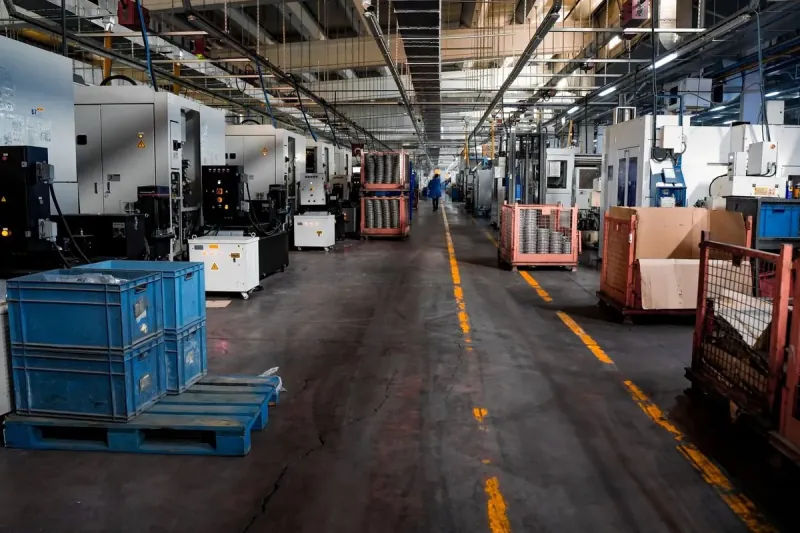
Industrial Robots Surpass Human Labour Across The Entire Manufacturing Sector.
70ba982e70df5fb6 · Resolution source: link.springer.com · link.springer.comIndustrial Robots Surpass Human Labour Across The Entire Manufacturing Sector.
Industrial Robots Surpass Human Labour Across The Entire Manufacturing Sector. Probability: 30%. Confidence Level: Low.
Will Industrial Robots Surpass Human Labor In Manufacturing By 2030?
Forecasts suggest a 30% probability that industrial robots will surpass human labor across the entire manufacturing sector by 2030. This prediction is based on current automation trends, robot density growth, and persistent bottlenecks in tasks requiring dexterity and flexibility. The verification criterion is that the number and production capacity of industrial robots exceed human labor in manufacturing.
Why Is Full Automation In Manufacturing Unlikely By 2030?
Achieving a complete surpass requires massive transformation of production processes. Robot density is increasing globally, especially in automotive and electronics sectors. However, many tasks remain resistant to automation due to the need for fine motor skills, adaptability to irregular environments, and complex decision making. According to the International Federation of Robotics (IFR), global robot density reached 151 robots per 10,000 employees in 2023, yet this still represents a fraction of total manufacturing tasks. The World Economic Forum estimates that by 2025, machines will perform 47% of work tasks, not 100%.
What Are The Main Barriers To Replacing Human Workers?
Key barriers include high capital costs for custom automation, technical limits in unstructured tasks (e.g., wiring harness assembly, quality inspection with subjective judgment), and the need for human oversight in safety critical processes. A 2023 study by MIT and Boston University found that only 23% of wages paid for vision tasks could be automated cost effectively. Additionally, small and medium manufacturers often lack the scale to justify robotic investment. As noted by the McKinsey Global Institute, less than 5% of occupations can be fully automated with current technology.
How Fast Is Industrial Robot Adoption Growing?
Annual installations of industrial robots reached 553,052 units in 2022, a 5% increase from 2021, according to IFR data. China is the largest market, accounting for 52% of installations. However, growth is uneven. While large factories in automotive and electronics are rapidly automating, sectors like apparel, furniture, and food processing remain labor intensive. The Boston Consulting Group projects that by 2030, robots will handle only about 30% of manufacturing tasks globally under current trajectories, not a majority.
Could Collaborative Robots Change The Timeline?
Collaborative robots (cobots) are designed to work alongside humans, not replace them. Cobot sales grew by 31% in 2022, but they still represent only 8% of total robot installations. Cobots improve productivity and reduce physical strain, yet they do not eliminate the need for human presence. Their role is augmentation, not substitution. For a full surpass, the industry would need a paradigm shift in artificial intelligence, including general purpose manipulation and real time learning, which remains in research stages.
What Is The Realistic Scenario For 2030?
A more plausible scenario is hybrid manufacturing, where robots handle repetitive, heavy, and precise tasks, while humans manage exceptions, customization, and final assembly. The International Labour Organization (ILO) warns that automation will displace some jobs but also create new roles in robot maintenance, programming, and system design. Net employment effects are uncertain, but a full surpass is unlikely without breakthroughs in energy efficient actuators, sensor fusion, and edge AI. Given current investment cycles and regulatory frameworks, the 30% probability is reasonable.
Frequently Asked Questions
Q1: Will Industrial Robots Eliminate All Factory Jobs By 2030?
No. Even with rapid adoption, robots are projected to handle only 30% of manufacturing tasks by 2030, according to Boston Consulting Group. Jobs requiring dexterity, judgment, and human interaction will persist. Many roles will shift to robot supervision and maintenance.
Q2: What Industries Are Most Likely To See Robot Dominance First?
Automotive and electronics are leading, with robot density above 1,000 per 10,000 workers in some plants. However, sectors like textiles, food processing, and construction remain below 50 robots per 10,000 workers due to task variability and cost sensitivity.
Q3: How Can Manufacturers Prepare For Partial Automation?
Companies should invest in workforce retraining, modular automation systems, and data infrastructure. The World Economic Forum recommends a skills first approach, focusing on human robot collaboration, not replacement. Pilot projects in flexible cells can reduce risk and build internal capabilities.
Sources: International Federation of Robotics (IFR), World Economic Forum, McKinsey Global Institute, Boston Consulting Group, MIT and Boston University joint study, International Labour Organization (ILO).
Related Predictions
- Robotic Surgical Systems Become Standard In All Surgical Procedures. 2030 · Robotics
- Humanoid Robots Work At Human Level In Daily Household Tasks. 2030 · Robotics
- Global Average Factory Robot Density Exceeds 250 Units Per 10,000 Employees In 2030, With Automation Investment Accelerating Across Europe And North America Behind Korea, China And Singapore. 2030 · Robotics
- Robotic Surgical Systems Enter Routine Use In Remote Surgery. 2029 · Robotics
- Industrial Robots Become Standard Across The Entire Manufacturing Sector. 2029 · Robotics